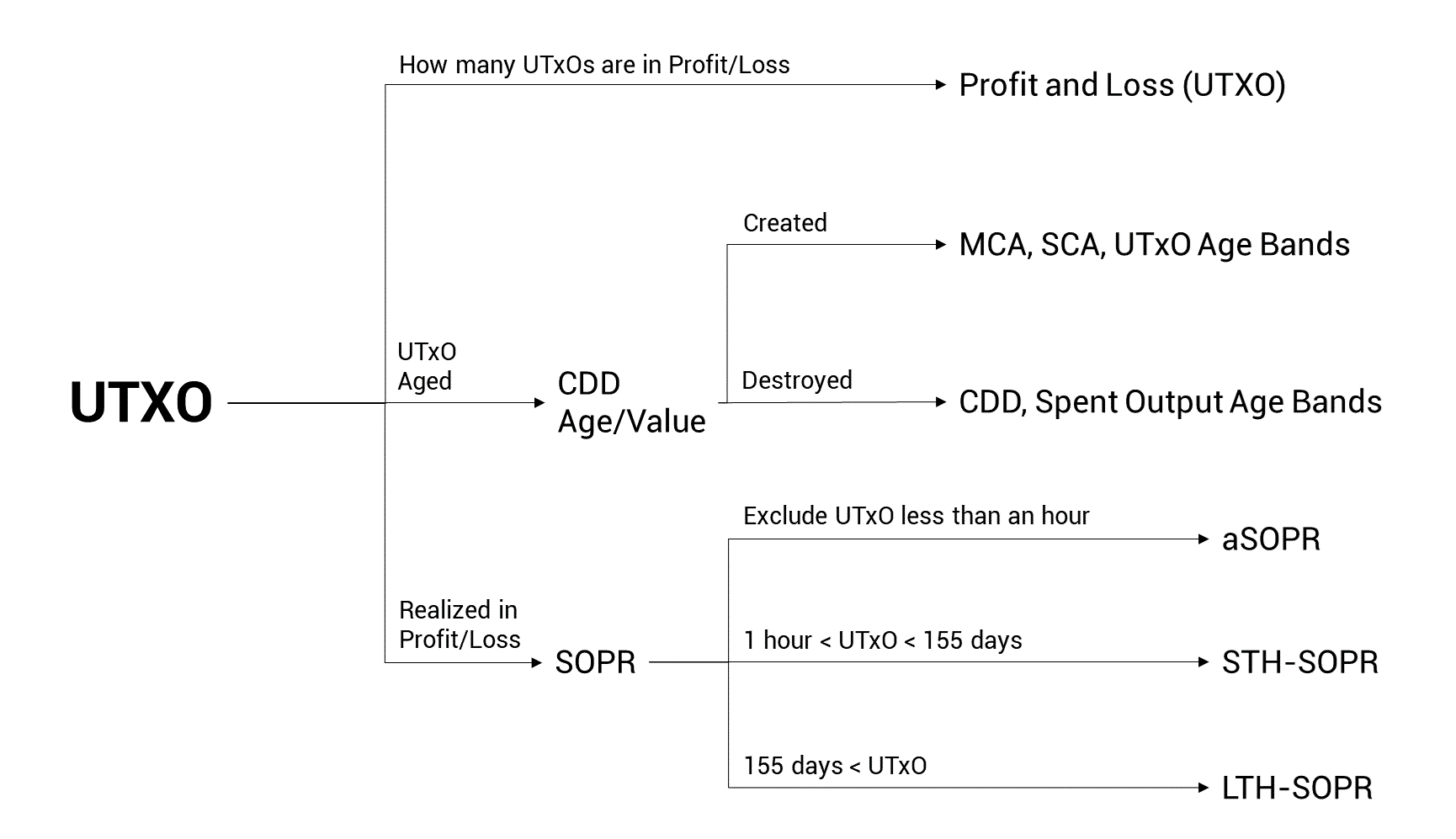
# UTxO Data/Indicators

| Data/Indicator                                                                                  | Definition                                                                                                                                                                                                   | Interpretation                                                                                                                                                                                                                                                                                                                                                                                                                                                                                                                                                                                                                                                            |
| ----------------------------------------------------------------------------------------------- | ------------------------------------------------------------------------------------------------------------------------------------------------------------------------------------------------------------ | ------------------------------------------------------------------------------------------------------------------------------------------------------------------------------------------------------------------------------------------------------------------------------------------------------------------------------------------------------------------------------------------------------------------------------------------------------------------------------------------------------------------------------------------------------------------------------------------------------------------------------------------------------------------------- |
| [What is a UTxO?](/what-is-cryptoquant/background-knowledge/what-is-a-utxo.md)                  | It stands for unspent transaction output(UTxO)                                                                                                                                                               | <p>-What is UTxO</p><p>-How UTxOs are created and destroyed</p>                                                                                                                                                                                                                                                                                                                                                                                                                                                                                                                                                                                                           |
| [Profit and Loss (UTxO)](/cryptoquant-metrics/utxo/profit-and-loss-utxo.md)                     | <p>The amount/ratio of UTxOs being in profit or loss </p><p></p><p>-Amount</p><p>The number of UTxOs being in profit/Loss</p><p></p><p>-Profit/Loss Percent</p><p>Ratio of the number of UTxOs being in </p> | <p></p><p></p><ul><li><p>Numbers of UTxOs that are in Profit</p><p><a href="https://cryptoquant.com/overview/btc-network-indicator/16432?window=day">Profit amount</a></p></li><li><p>Numbers of UTxOs that are in Loss</p><p><a href="https://cryptoquant.com/overview/btc-network-indicator/16433?window=day">Loss Amount</a></p></li><li><p>Ratio of UTxOs that are in Profit</p><p><a href="https://cryptoquant.com/overview/btc-network-indicator/16434?window=day">Profit percent</a></p></li><li><p>Ratio of UTxOs that are in Loss</p><p><a href="https://cryptoquant.com/overview/btc-network-indicator/16435?window=day">Loss percent </a></p><p></p></li></ul> |
| [Coin Days Destroyed (CDD)](/cryptoquant-metrics/utxo/coin-days-destroyed-cdd.md)               | The sum of UTxO's alive days and its value                                                                                                                                                                   | <p></p><ul><li><p>High</p><p>Long-held coins are moving in great amounts - <strong>Bearish</strong></p></li><li><p>Low</p><p>Long-held coins are moving in less amount    - <strong>Bullish</strong></p></li><li><p>Increasing</p><p>Increasing Selling pressure - <strong>Bearish</strong></p></li><li><p>Decreasing</p><p>Decreasing selling pressure - <strong>Bullish</strong></p></li></ul>                                                                                                                                                                                                                                                                          |
| [Mean Coin Age (MCA)](/cryptoquant-metrics/utxo/mean-coin-age-mca.md)                           | The mean value of products of coin unspent transaction output (UTxO) alive days and its value                                                                                                                | <ul><li><p>Continuous rise</p><p>The total days of coins alive accumulate              - <strong>Bullish</strong></p></li><li><p>Sudden decrease</p><p>Coins that were dormant moved in mass                - <strong>Bearish</strong></p></li></ul>                                                                                                                                                                                                                                                                                                                                                                                                                      |
| [Spent Output Profit Ratio (SOPR)](/cryptoquant-metrics/utxo/spent-output-profit-ratio-sopr.md) | Spent Output Profit Ratio (SOPR) evaluates the profit ratio of the whole market participants by comparing the value of outputs at the spent time to created time                                             | <p><a data-mention href="/pages/JS7WHMfYk1wIhCA22v1p">/pages/JS7WHMfYk1wIhCA22v1p</a></p><p>Modified SOPR that eliminated noises</p><p></p><p><a data-mention href="/pages/4WgkPhxN3HnQEu7WTHkw">/pages/4WgkPhxN3HnQEu7WTHkw</a></p><p>Modified SOPR that focuses on the behavior of short-term UTxOs.</p><p></p><p><a data-mention href="/pages/OgNjI6y85n2FdLvN9L2O">/pages/OgNjI6y85n2FdLvN9L2O</a></p><p>Modified SOPR that focuses on the behavior of long-term UTxOs.</p>                                                                                                                                                                                           |

## Reason to look for UTxO indicators

### Best for tracking down Long term holders

It is reasonable to assume that long-term holders' bags are "Smart money" and it provides valuable insight for investors to notice their movements if they start to move in anyways. What makes these indicators better is that the longer the bitcoin holder had, the more sensitive indicator is to the movement of the long-lived UTxOs.&#x20;

The longer-lived UTxOs move, the more change in values for these indicators enabling people who use this metric to notice the difference easily. Thus, the best way to capture these "Smart money" movements is through utilizing UTxOs.&#x20;

Also because UTxOs are like traceable cash with the wallet's name on it, it is also possible to  easily trace the record of how long those UTxOs are held. It is best at tracking long held coins but also easy to differentiate investors by age and draw behavior indications from tracking them.&#x20;

## How to look at indicators

This section identifies the lookout point for individual indicators. These indicators could be divided by their identity and their usefulness in trading. Each indicator utilized each feature of UTxOs and  put together they cover multiple aspects and capture movements in UTxO relatively precisely.&#x20;

If you want to make use UTxO's feature of by figuring out

### 1) How many UTxOs itself is in profit or not

Checking the absolute number of UTxO in Profit or loss

{% content-ref url="/pages/-Mi\_M-D7FkB16xY4C9WL" %}
[Profit and Loss (UTxO)](/cryptoquant-metrics/utxo/profit-and-loss-utxo.md)
{% endcontent-ref %}

### 2) Focusing on figuring out the days of UTxO lived or destroyed

{% content-ref url="/pages/-Mi\_LtJlXw3P-nKBxnhb" %}
[Sum Coin Age (SCA)](/cryptoquant-metrics/utxo/sum-coin-age-sca.md)
{% endcontent-ref %}

{% content-ref url="/pages/-Mi\_Llz7d8keQpKy4Aw5" %}
[Coin Days Destroyed (CDD)](/cryptoquant-metrics/utxo/coin-days-destroyed-cdd.md)
{% endcontent-ref %}

### 3) Closer look on whether or not certain kinds of UTxOs were moved in profit or not&#x20;

{% content-ref url="/pages/-Mi\_KteakN6ufOHt\_bJx" %}
[Spent Output Profit Ratio (SOPR)](/cryptoquant-metrics/utxo/spent-output-profit-ratio-sopr.md)
{% endcontent-ref %}

It is wise to take a look at each indicator according to the number stated above.

## Points to be aware

When the UTxOs are moved, it doesn't necessarily mean that all of them are sold or bought.

Relating any UTxO movement to trade-related actions and applying them to the indicators would not fit the purpose of the creation of these indicators. For instances of internal wallet movement, the UTxO does move, but it does not necessarily have to do with price issues.&#x20;

However, it is important to note that any kind of movement on the chain exposes the wallet to the security cost of sending to a wrongful address, getting into on-chain radar just by moving, and paying fees to have any kind of transaction.

Thus, it is quite reasonable to assume that every transaction has to have a purpose behind it.

<figure><img src="/files/Wsr45WOCz0FqVKb0pvEJ" alt=""><figcaption></figcaption></figure>


---

# Agent Instructions: Querying This Documentation

If you need additional information that is not directly available in this page, you can query the documentation dynamically by asking a question.

Perform an HTTP GET request on the current page URL with the `ask` query parameter:

```
GET https://userguide.cryptoquant.com/cryptoquant-metrics/utxo.md?ask=<question>
```

The question should be specific, self-contained, and written in natural language.
The response will contain a direct answer to the question and relevant excerpts and sources from the documentation.

Use this mechanism when the answer is not explicitly present in the current page, you need clarification or additional context, or you want to retrieve related documentation sections.
